Nashville's Retaining Wall Contractor
Structural retaining walls engineered for Tennessee's clay soils, heavy rainfall, and seasonal freeze-thaw. Concrete, segmental block, and stone, all built with drainage systems that prevent the failure patterns common in retaining walls across Middle Tennessee.
Retaining Walls in Nashville and Middle Tennessee
Middle Tennessee’s topography creates significant demand for retaining walls. The Nashville metro has rolling terrain across most of its residential markets. Brentwood’s hillside estates, East Nashville’s ridgeline properties, the lakefront lots of Hendersonville, and the developing corridors of Williamson County all involve grade changes that require engineered soil retention.
The quality spectrum in Nashville’s retaining wall market is wide. At the low end, minimum-spec block walls set on minimal bases with no drainage engineering. At the high end, engineered poured concrete or engineered block systems built with full drainage infrastructure and documented specifications. Pumas Concrete builds in the latter category.
How We Design Retaining Walls
Every retaining wall project begins with a site drainage evaluation. We assess:
Soil type and drainage characteristics. Nashville’s clay-heavy soils are the primary driver of wall failure. We evaluate how water moves through the site during heavy rain events and where it accumulates.
Grade and load conditions. What is the height of the wall? What soil mass is it retaining? Is there a structure, driveway, or vehicle traffic at the top of the wall that adds surcharge load?
Footing requirements. Footings must go below both frost depth and the active clay zone to prevent seasonal movement. In Nashville, this means excavating to 18-24 inches in most locations.
Drainage system design. Every wall we build includes a drainage system: aggregate backfill (gravel against the wall face), perforated drain pipe at the footing level running to daylight, and weep holes at the base of the wall face at appropriate spacing. This is not optional.
Types of Retaining Walls We Build
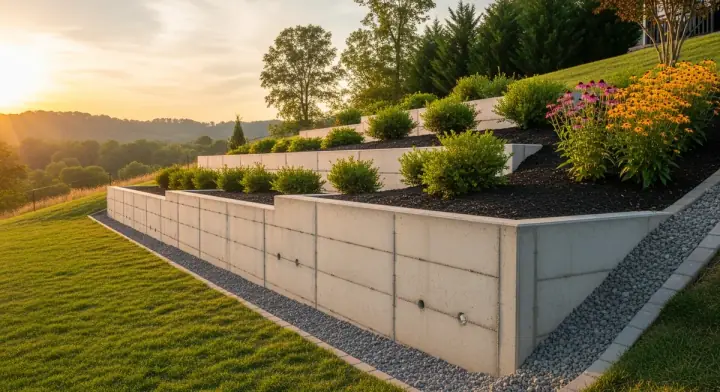
Poured concrete retaining walls. Monolithic walls formed and poured to a structural specification. Best for taller applications, heavy surcharge loads, and situations where maximum strength per linear foot is required. Can be finished smooth, board-formed for texture, or faced with stone or brick veneer.
Segmental block retaining walls. Interlocking concrete block systems (Versa-Lok, Allan Block, or equivalent) engineered for the specific wall height and load conditions. More flexible on curved alignments and can be installed in segments. Require geogrid reinforcement at specified intervals for walls above 4 feet.
Stone retaining walls. Natural stone walls set on concrete footings with drainage engineering. Better suited for shorter walls (under 3 feet) where aesthetics are the priority. For taller stone walls, we recommend a concrete structural base with stone veneer facing.
Residential and commercial retaining walls. We build walls for both homeowners managing grade changes on their property and commercial developers managing grade transitions on development sites. Commercial walls often require engineering documentation and inspector sign-offs.
Retaining Wall Service Area
We build retaining walls throughout Nashville and Middle Tennessee: Brentwood, Franklin, Spring Hill, Nolensville, Murfreesboro, Hendersonville, Lebanon, Clarksville, and the Nashville city limits. Site consultations are scheduled within one week for most locations.
What We Do as Your Retaining Wall Contractor Nashville TN
PSIP Protocol. Every Project.
4000 PSI Concrete · Full Rebar Grid · California Sand Finish · Structural Longevity Certificate
Ready for Retaining Wall Contractor Nashville TN Work in Nashville?
PSIP certified. Structural Longevity Certificate included. Minimum $30,000 project. Get your free consultation today.
Retaining Wall Contractor Nashville TN — Frequently Asked Questions
Common questions about retaining wall contractor nashville tn in Nashville and Middle Tennessee.
The most common cause of retaining wall failure in Middle Tennessee is inadequate drainage. Clay soil absorbs water slowly and retains it, building hydrostatic pressure behind the wall. Without proper drainage relief, meaning aggregate backfill, perforated pipe, and weep holes, this pressure accumulates through each wet season until it cracks, tilts, or overturns the wall. A secondary cause is inadequate footing depth: footings placed above the active clay zone move seasonally with moisture changes, destabilizing the wall over time.
Permit requirements vary by jurisdiction and wall height. In the Nashville metro area, walls under 4 feet typically do not require a permit. Walls 4-6 feet usually require a building permit. Walls over 6 feet often require a structural engineer's stamped drawing in addition to the permit. Walls near property lines have setback requirements regardless of height. We advise on permit requirements during the site consultation.
Poured concrete retaining walls are monolithic, one continuous structure. They are the strongest option for taller walls or sites with significant soil pressure. Segmental block (modular or segmental retaining wall systems) uses interlocking concrete units that do not require mortar. Block walls are more flexible in appearance and easier to install on curved alignments. For walls under 4 feet, block often makes sense. For walls over 4 feet or on sites with difficult drainage conditions, poured concrete is generally the stronger long-term choice.
It depends on the wall and the failure mode. Walls that have cracked or shifted but retain their structural mass can sometimes be stabilized. Walls that have overturned or lost structural integrity typically require demolition and replacement. Partial repairs to a structurally compromised wall rarely hold. We diagnose the failure cause first: if it is a drainage failure, we correct the drainage before any wall repair or replacement, or the new wall will fail the same way.
Cost varies significantly based on wall height, linear footage, material type, drainage conditions, and site access. General ranges for Middle Tennessee: short walls 2-3 feet start around $150-$250 per linear foot for simple sites; mid-height walls 4-6 feet run $300-$500 per linear foot with drainage engineering; tall or complex walls over 6 feet require site-specific engineering and pricing. We provide written specifications with every estimate.
Still have questions? We're happy to talk through your project.
Contact Us