
If you’re researching concrete driveway costs in Nashville, you’re seeing a wide range: from $5,000 quick-pour bids to $50,000+ premium installs for the same square footage. Most homeowners assume that variance reflects contractor markup. It doesn’t. It reflects specification.
This post is the breakdown we wish more homeowners had before they signed.
The four cost drivers (in order of impact)
1. Mix specification
A 3,000 PSI standard mix and a 4,000 PSI engineered mix come from the same plant, drive on the same trucks, and pour the same way. The cost difference at the ready-mix plant is roughly $8 to $12 per cubic yard. On a typical 800-square-foot driveway, that’s $200 to $300 in materials.
Most Tennessee contractors specify 3,000 PSI to keep their bid low. Pumas specifies 4,000 PSI on every pour. The cost difference is small. The lifespan difference is decades.
2. Reinforcement
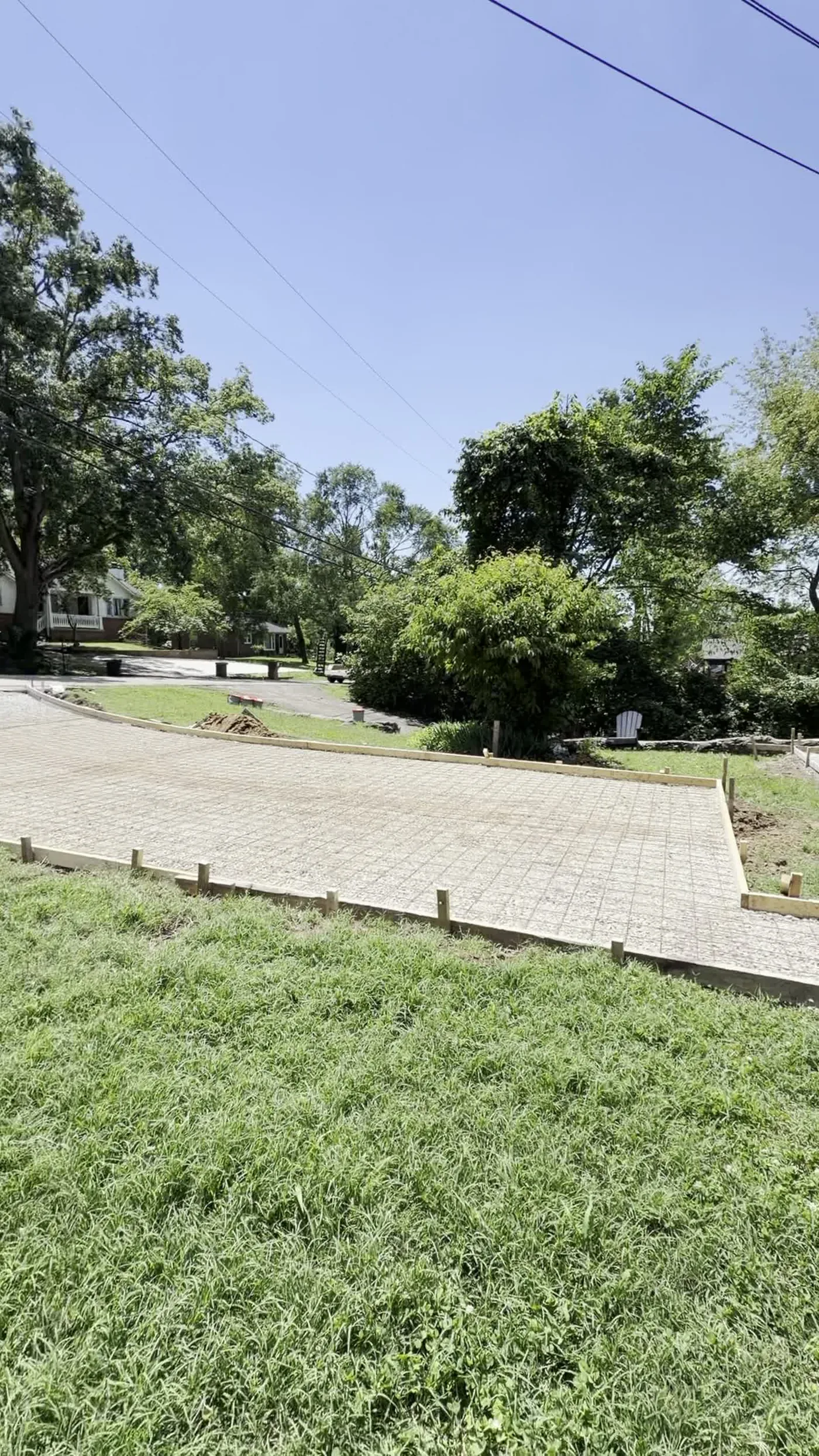
Wire mesh and rebar grids are not the same product. A wire mesh roll for an 800-square-foot driveway runs $200 to $400 in materials. A structural rebar grid with chair rails for the same square footage runs $1,200 to $1,800.
The labor to install wire mesh is 30 minutes (roll it out, walk away). The labor to install a rebar grid on chair rails is 4 to 6 hours (cut, tie, position, elevate). So the bid difference between a wire mesh job and a rebar job isn’t $1,000. It’s $1,500 to $2,500.
That spread is exactly the gap between a contractor charging $9,000 for a driveway and one charging $12,000 for the “same” driveway. The product isn’t the same.
3. Base preparation
Most Nashville driveways are poured directly onto the existing soil after a quick scrape. Pumas specifies excavation to 6 inches below grade, a graded crushed-stone sub-base, mechanical compaction, and SSD pre-hydration. That sequence adds half a day of labor and $400 to $800 in materials per project.
It also adds 20 to 30 years of slab lifespan. The base is what holds the slab against Tennessee clay’s seasonal moisture cycling. Skip it and the slab sits on a moving foundation.
4. Finishing
Machine-only finishing on an 800-square-foot driveway takes 1 to 2 hours. Adding a California hand-finish pass adds 3 to 5 hours of skilled labor (the finisher has to time the pass precisely as the surface sets). At trade-skilled wage, that’s $300 to $500 in additional labor.
Machine finishing leaves the wear layer porous. The hand-finish step seals it. Year five, you can see the difference.
What a Pumas driveway actually runs
Realistic ranges for residential work in Middle Tennessee, based on what we actually quote:
- Repair or partial replacement of a failing section: $2,000 – $6,000
- Standard replacement, 600–800 sq ft, plain finish: $9,000 – $16,000
- Mid-size driveway, 1,000–1,400 sq ft, with some decorative work: $16,000 – $30,000
- Large driveway or motor court, 1,500+ sq ft, decorative finish, grading or retaining work: $30,000 – $90,000
Those numbers look high next to an $8,000 quote from a guy with a truck, and on the day it is poured you will not be able to tell the two apart. The comparison that matters is not our bid against his. It is one driveway against two, because the cheap one gets replaced while yours is still flat.
There is no minimum project size. If the honest answer is a repair rather than a replacement, we will tell you.
Three questions to ask any concrete contractor before signing:
- What’s the PSI rating of the mix you’ll specify? (3,000 = standard. 4,000+ = premium.)
- What reinforcement, and at what elevation? (Wire mesh on grade = standard. Rebar on chair rails = premium.)
- Will the surface be machine finished or hand finished? (Machine = utility. Hand-finished = architectural.)
If you can’t get clean answers to those three questions, you’re not buying a documented product. You’re buying whatever shows up on pour day.
Related reading:
- Why 90% of Nashville Driveways Fail Within a Decade: what the cheaper specification actually costs you
- California Sand Finish: What It Is and Why It Matters: why the finish step separates architectural concrete from utility concrete
- Concrete Driveways: how we build them
Found this useful? Share it.